



Orange County Multifamily Market Overview: Q4 2025 Insights
In the fourth quarter of 2025, Orange County’s multifamily market exhibited a notable transition as developers navigated a landscape marked by economic fluctuations and investor sentiments. This period witnessed a slight uptick in vacancy rates and a decrease in average asking rents, while overall sales activity signaled a cautious yet selective confidence among investors in the region.
Market Dynamics: Construction and Vacancy Trends
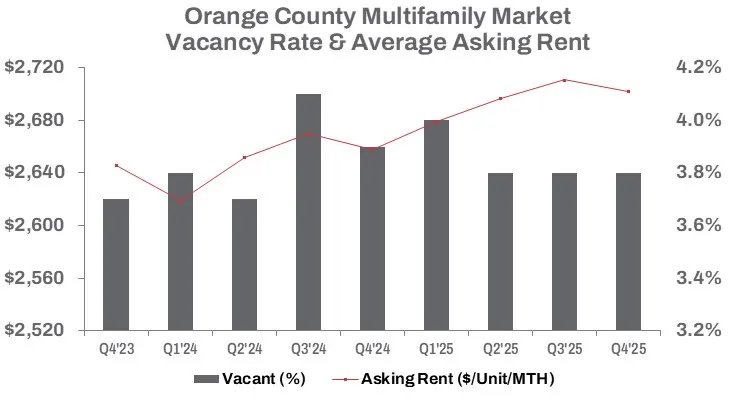
During Q4 2025, the multifamily sector in Orange County saw a marginal increase in vacant units, totaling 11,926—reflecting a 0.1% rise from the previous quarter. However, this figure represents a year-over-year decline of 1.6%, suggesting a controlled supply environment. Builders delivered 430 new units in Q4, a significant 26.2% drop from Q3. This slowdown, attributed to stricter financing conditions and mixed demand indicators, culminated in a year-to-date delivery figure of 1,979 units, down 43.1% from the previous year. Such figures illustrate developers’ cautious approach as they adapt to the evolving market dynamics.
The vacancy rate stagnated at 3.8%, indicating stable rental demand even amidst softer absorption rates. Year-over-year vacancy improvement of 10 basis points counters the narrative of excessive supply, showcasing that demand for rental units remains resilient. Despite only a slight decline in average rents—down $9.00 to $2,702 per unit—the market experienced a 1.7% increase in rent prices compared to last year. This context is juxtaposed against the backdrop of a significant drop in construction activity, underlining the lasting demand pressures faced by the county.
Rents and Economic Pressure
As the market evolved in Q4, average asking rents demonstrated a minor retreat after reaching a peak in the previous quarter. Despite this, the 1.7% year-over-year increase illustrates a resilient rental market amidst economic challenges. The previously favorable conditions of 2024 saw 3,475 new units delivered, indicating a recent peak in construction, highlighting the abrupt decline this year as rising construction costs and escalating interest rates deterred new developments. Currently, 4,775 units remain under construction, with a drop of 11.1% from Q3, signifying continued caution among developers regarding future project viability.
This cautious stance reflects a broader concern surrounding affordability, which remains a pivotal issue in the region. As construction slows and economic headwinds persist, the multifamily market’s ability to maintain competitive rents becomes critical for both renters and investors aiming to navigate the challenges of increased borrowing costs and construction volatility.
Sales Activity: A Mixed Landscape
Sales activity in the multifamily sector presented a contrasting narrative, with a noteworthy uptick of 18.1% in transaction volume quarter-over-quarter. Year-to-date, however, sales figures declined by 15.2% to nearly $1.9 billion, signaling shifting market dynamics. Investors acquired 5,231 units throughout the year; nonetheless, unit sales decreased by 9.9% from 2024, underscoring sellers’ need to reconcile pricing expectations with current market realities.
The average price per unit settled at $386,605, which reflects an 11.1% drop from Q3 yet a 1.7% increase year-over-year. The increase in late-year sales indicates institutional buyers’ interest, particularly in well-located assets, suggesting optimism for long-term rent growth despite economic uncertainties ahead. Notably, the number of transactions involving 100-plus unit properties in 2025 rose to 11, compared to 10 in the previous year, indicating a burgeoning but selective investment interest in larger multifamily units.
Noteworthy Transactions and Resilience
Among the significant transactions recorded in Q4 was the sale of a 333-unit senior housing community, which sold for $160 million or $480,480 per unit. This transaction underscores ongoing affordability pressures and highlights community needs, especially for residents earning up to 60% of the area median income. With affordability restrictions in place since 2002, this sale reveals how institutional investors are creatively addressing housing shortages.
Another standout transaction involved The REVO apartments, trading for $152.19 million, or $460,693 per unit—marking it as the highest-priced asset in its multi-state portfolio sale. This purchase not only emphasizes the strength of Orange County’s market but also suggests that, despite economic challenges and borrower caution, there remains a core resilience among multifamily assets positioned strategically within the market.
Looking Ahead: Key Trends and Future Outlook
As the multifamily market in Orange County continues to adapt to economic shifts and changing employment trends, several key trends warrant attention. Affordability challenges persist and heavily influence rental demand, albeit at a moderated pace. Rising borrowing costs are increasing financial risks, yet selective demand for certain asset classes remains strong.
Though only four transactions involving properties above 100 units were recorded in Q4, the ongoing interest in stabilized multifamily properties remains a positive sign for the long-term viability of the sector. As investors remain discerning—prioritizing fundamental metrics and well-located assets—the market’s evolution will hinge on navigating higher borrowing costs while balancing supply and demand dynamics.
Conclusion: Adjusting in Uncertain Times
In summary, the Orange County multifamily market is exhibiting signs of adjustment amidst economic transformations. The flat vacancy rates, moderated rent growth, and investor resilience showcase a sector in transition. With diminishing construction activity and cautious investor sentiment, the market is positioned to navigate short-term challenges while retaining long-term potential. As economic conditions evolve, continued monitoring of market trends will be essential for stakeholders invested in the area’s multifamily landscape.
This article is based on reporting from theregistrysocal.com.
The original version of the story can be found on their website.
Original Source:
theregistrysocal.com
Image Credit: theregistrysocal.com ·
View image


