Understanding Trapped Waves: The Hidden Forces Behind Ocean Surf Dynamics
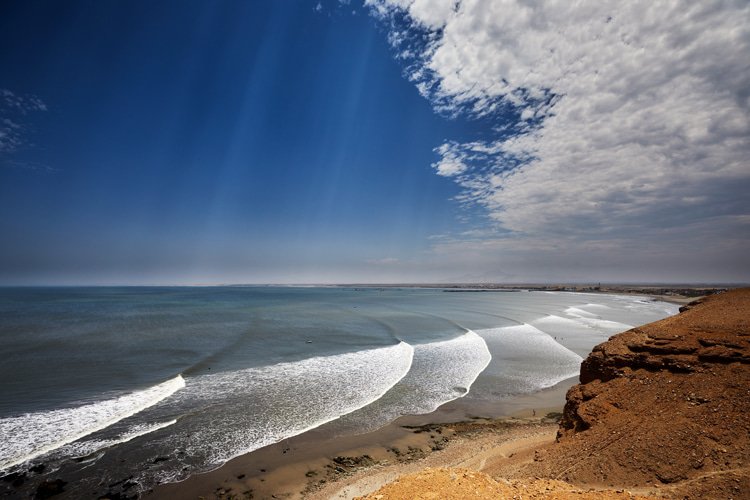
When ocean waves approach the shore, they rarely do so in a straight line. Instead, they arrive at an angle, and this seemingly simple detail can lead to a fascinating phenomenon known as trapped waves. Described by Willard Bascom in his influential book, Waves and Beaches, trapped waves occur when waves strike the beach at an angle, especially in areas where the underwater slope drops steeply into deeper waters. This process not only alters the wave’s path but also redistributes energy, creating a repeating pattern that significantly impacts the dynamics of the shore. Here’s a deeper dive into the concept of trapped waves and their effects.
The Mechanics of Wave Trapping
To visualize how waves become trapped, imagine a single wave approaching the beach diagonally. As the first portion of the wave hits shallow waters, it breaks and begins to reflect back toward the sea. However, because the rest of the wave is still coming in, a staggered timing occurs. Bascom elaborated on this, stating, “The first part of the wave front to strike the beach is reflected and already moving seaward when the next part of the front reaches the sand.” This staggered interaction between incoming and outgoing waves creates a loop where some of the wave energy is captured rather than lost.
Waves travel in paths called orthogonals, which are perpendicular to the wave front. When these energy paths hit the shore, they reflect outward and then bend back toward the coast due to a phenomenon known as refraction. As a result, rather than escaping into deep waters, the wave energy gets caught in a continuous cycle along the shoreline, creating a mesmerizing, almost magical effect.
Energy Redistribution Along the Shoreline
The behavior of trapped waves isn’t random; it follows a consistent curved path that is shaped by the ocean floor’s depth. As waves transition into deeper waters, they speed up and bend. When they return to shallower areas, they slow down and bend again, reinforcing the cycle of energy distribution. Bascom notes that these orthogonals, once starting from the sea, curve back toward the beach, thus enabling trapped waves to remain in a sustained loop along the shore.
Although not all wave energy makes it through each reflection, a significant portion can be retained. Up to 30 percent of the energy can reflect and continue through the cycle, which is vital for sustaining trapped waves. However, with each cycle, the energy dissipates, causing the waves to weaken over time. As they spread out, more energy dissipates into deeper water through a process called diffraction, making these waves gradually smaller with each subsequent cycle.
Theoretical Foundations and Scientific Discoveries
Interestingly, the phenomenon of trapped waves was predicted through theoretical frameworks rather than observed directly by surfers or beachgoers. Groundbreaking research in this area began in 1952 by John Isaacs and Carl Eckart at the Scripps Institution of Oceanography. They described trapped waves, and later, Walter Munk expanded on this theory with mathematical models, introducing the term "edge waves." Despite their theoretical foundations, trapped waves remain challenging for scientists to study in real-world conditions, mainly due to their complex paths and the splitting of energy into smaller waves.
This complexity makes it difficult to map trapped waves accurately, and they’re often overlooked in oceanography and surf forecasts. However, their implications are significant: understanding trapped waves can provide insights into coastal dynamics and wave behavior.
Impact on Surfers and Coastal Dynamics
Even if trapped waves aren’t directly visible, their effects can be felt by surfers and coastal enthusiasts alike. These waves facilitate energy transfer along the coastline, allowing energy to move sideways rather than just straight toward land. According to Bascom, this process may play a crucial role in the "alongshore propagation of surf beat," which refers to sudden short-term rises in water levels due to groups of larger waves.
Trapped waves can also influence the beach’s physical features, contributing to erosion patterns, sediment deposition, and the formation of unique shoreline forms known as cusps. These rounded arcs along the water’s edge are often shaped by the interplay of trapped waves and can be seen at various beaches. Additionally, surfers might notice that the energy leading to wave formation is influenced by factors other than direct ocean swell, which explains why some beach spots feel more powerful than others on certain days.
The Bigger Picture: Why Understanding Trapped Waves Matters
In summary, trapped waves represent a captivating aspect of ocean wave dynamics, illustrating how even subtle changes in wave approach can lead to profound consequences for coastal behavior. By understanding the mechanics behind trapped waves, surfers and coastal managers can better comprehend how energy travels along the shore, shaping not just the waves they ride but also influencing beach erosion and sediment dynamics.
For those interested in further exploring this topic, detailed resources can be found at SurferToday.com and in publications like Bascom’s Waves and Beaches. Understanding these natural phenomena can enhance our appreciation of ocean dynamics, surf conditions, and the ongoing processes that shape our coastlines. As science continues to advance, so too does our grasp of the complexities behind trapped waves and their role in the intricate dance between land and sea.
This article is based on reporting from www.surfertoday.com.
The original version of the story can be found on their website.
Original Source:
www.surfertoday.com
Image Credit: www.surfertoday.com ·
View image