





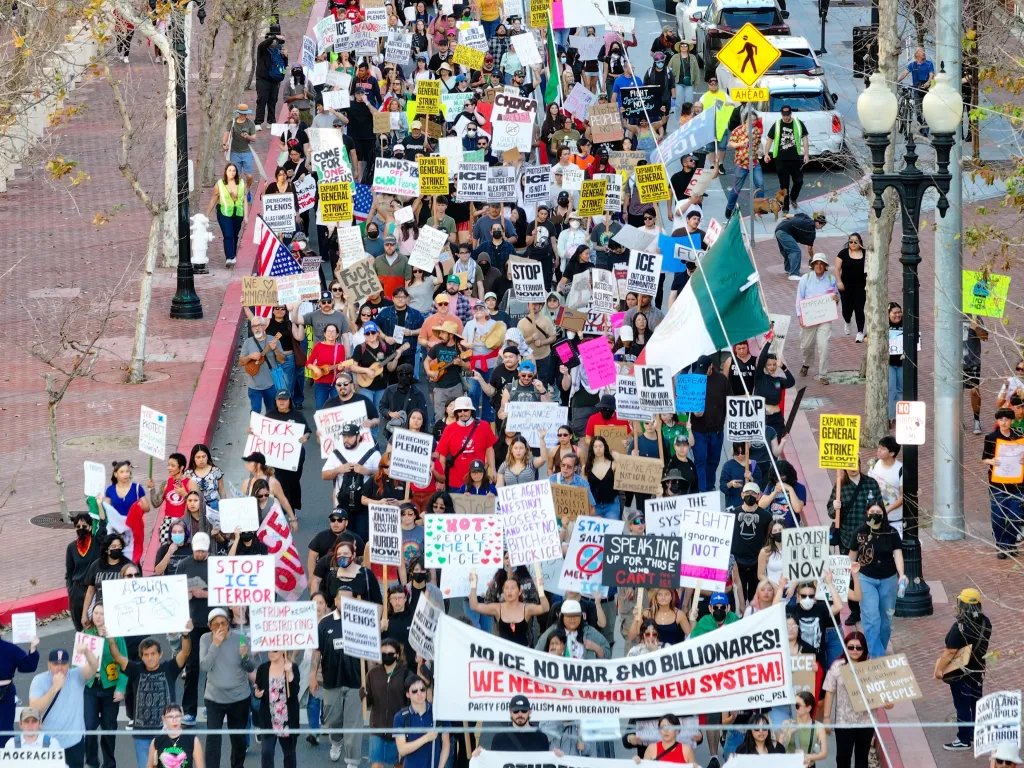
Southern California Rallies Against ICE: A Unified Call for Justice
On Saturday, Southern California became a hub of collective action as multiple anti-Immigration and Customs Enforcement (ICE) demonstrations took place in the wake of a nationwide ICE Out of Everywhere National Day of Action. Over 300 events unfolded across the country as citizens united to voice their demand for the complete removal of ICE, the Department of Homeland Security (DHS), and Customs and Border Protection (CBP) from communities. The organizers, a coalition known as 50501 SoCal, stated that everyday Americans are taking a stand against what they viewed as the unjust treatment of immigrants in America.
In Torrance, a protest organized by Indivisible South Bay LA drew approximately 2,500 people. As demonstrators gathered outside the Del Amo Shopping Center, the atmosphere was characterized by continuous honks from supportive drivers and a fervent chant led by the crowd. Protesters held signs bearing messages like “Healthcare Not Warfare” and “I Like My ICE Crushed,” expressing their frustrations and hope for change. The crowd resonated with the anthem "We’re Not Gonna Take It," a clear indication of their determination to challenge the current political climate under President Trump.
Among the attendees was 94-year-old veteran Albert Hernandez, whose feelings on the current state of American democracy were palpable. Voicing his disappointment, he remarked on the “terror and unrest” that has gripped the nation. Having served in the military during significant global conflicts, Hernandez highlighted a drastic shift from the ideals of freedom and justice he had once anticipated for the country. “I never thought I would see such an ignorant president as we have today,” he lamented, representing a generation that has lived through multiple wars and is now facing a new kind of crisis.
The motivation behind many participants in the protests stemmed from specific events, such as the deaths of Alex Pretti and Renee Good, killed by federal immigration officers in Minneapolis. People of all ages participated, some citing personal fears regarding their friends’ safety and the increasing threat posed by ICE. One high school sophomore, Bria Owens, shared her concerns about her classmates avoiding school due to immediate ICE threats. This personal connection to the issue emphasized how the government’s policies are not just abstract discussions but serious fears affecting lives directly.
In Baldwin Park, smaller yet equally passionate gatherings continued, with about 40 individuals voicing their shared concerns against ICE enforcement. Protesters expressed solidarity with those affected by the current immigration policies, using slogans that ranged from “We Stand with Minneapolis” to “Make Orwell Fiction Again.” The fears articulated by demonstrators echoed sentiments of historical dystopias, showcasing how literature can mirror a disturbing reality. Local resident Hanna Hixson acknowledged this correlation, calling the current situation “out of hand” and raising alarms about ICE’s complete immunity from accountability.
The momentum built throughout the day was complemented by individuals committed to grassroots activism. In El Monte, around 70 community members met to discuss strategies for opposing ICE activities, reflecting an upsurge in citizen activism. Organizer Edgar Reyes highlighted the urgency of addressing the escalating violence in detention centers and the targeting of activists. His call to unity received an enthusiastic response from attendees, several of whom had traveled long distances to participate. They emphasized the need for community solidarity in the face of oppressive governmental actions.
As the weekend progressed, a variety of other events scheduled throughout Southern California aimed at continuing the momentum for change. Protests in cities like Compton and Culver City brought tailored efforts to their communities, underlining the local nature of the national movement against ICE. Organizers encouraged participation from citizens in various roles, from walkers to speakers, reinforcing the message that everyone can contribute to driving systemic change in immigration policy.
In a climate where tensions are high, and voices of dissent are often met with resistance, these demonstrations in Southern California reflect a broader national sentiment. As citizens unite to oppose ICE and advocate for immigrant rights, they aim to create a future defined by compassion, justice, and equality. These protests represent not just a moment in time but a significant movement fueled by an urgent need for systemic change, revealing the strength of community and collective action against oppressive forces.
This article is based on reporting from www.ocregister.com.
The original version of the story can be found on their website.
Original Source:
www.ocregister.com
Image Credit: www.ocregister.com ·
View image