





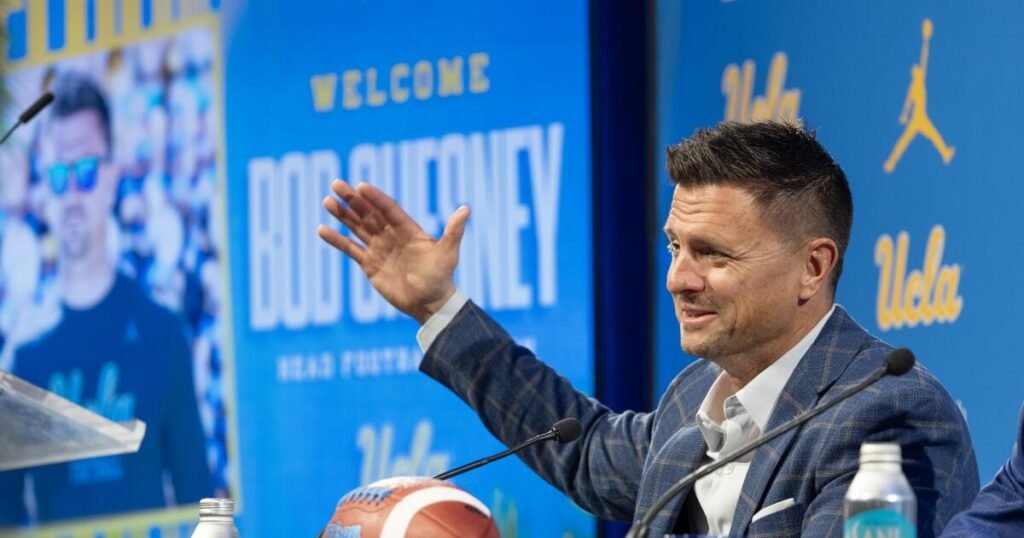
Bob Chesney: UCLA’s New Hope to Awaken the Football Giant
In a significant move for UCLA football, Bob Chesney has taken on the role of head coach, introduced with optimism as a catalyst for change. At 48, Chesney brings a fresh perspective, an articulate vision for success, and a welcoming demeanor that resonates with the Bruins’ community. During his introductory press conference, he made it clear that he believes in the potential of UCLA football to emerge from its prolonged dormancy, which many fans and analysts refer to as the “Sleeping Giant.” With a focused mission ahead, Chesney aims to revitalize a program historically marked by inconsistency and missed opportunities.
The Challenges of Reviving a Dormant Program
UCLA’s football history has been dotted with ambitious but ultimately unsuccessful coaching tenures. High-profile names like Bob Toledo, Rick Neuheisel, Jim Mora, and Chip Kelly have attempted to harness the school’s advantages, including its location in Los Angeles and rich academic reputation. Despite these efforts, none have succeeded in re-establishing UCLA as a nationally relevant powerhouse. This leads to a critical question: is the issue entrenched within the program, or do strict admission standards contribute to its struggles? Chesney is not deterred, boldly asserting his belief in UCLA’s winning capabilities. He emphasized during his introduction that failure is not an option, a sentiment that aims to invigorate both players and supporters.
Strong Support and Resources for Success
One notable distinction in Chesney’s hiring is the level of institutional support he will receive, which is significantly more substantial than what previous coaches had. Bob Myers, who served on the search committee, highlighted the financial commitment being made towards the football program, with Chesney set to earn an average of $6.75 million annually. This investment is not just for his salary; it encompasses a plan to assemble a capable coaching staff and provide the necessary resources to build a competitive team in the challenging landscape of college football. Such support is crucial, especially as UCLA transitions into the Big Ten, a conference known for its high-level competition.
Cultural Shifts Reflecting Leadership Commitment
UCLA’s new chancellor, Julio Frenk, has also played a pivotal role in this cultural shift. Unlike past administrations that were somewhat apologetic about the university’s athletic programs, Frenk has made it clear that athletics are integral to UCLA’s identity. This has created a more unapologetic environment where sports, particularly football, are being emphasized as a key component of the school’s public image. Myers noted that embracing the significance of football is crucial for success, especially given the fierce competition within the Big Ten. This attitudinal change reflects a leadership willing to prioritize athletics as a vital aspect of UCLA’s mission.
Inspiration from Other Programs
Citing successful transformations in other college football programs, Myers referenced Indiana, traditionally known for its basketball success. Under Curt Cignetti, Indiana has demonstrated what an ambitious mindset can achieve, recently competing at a national level and breaking long-standing records. This serves as a motivating example for UCLA, suggesting that the Bruins can similarly rise above tradition and expectation to become competitive in their own right. Chesney has adopted this belief, aligning himself with the notion that UCLA has the potential to overcome past failings and succeed in a demanding framework.
A New Era of Confidence and Determination
UCLA fans have seen their team oscillate between hope and disappointment over the years. However, with Bob Chesney at the helm, there is renewed belief that the Bruins can reclaim their former glory. Armed with confidence and institutional backing, Chesney is poised to make a significant impact. He emphasizes that the responsibility lies not just with the players but across the entire university community to strive for excellence. With a fresh perspective, ample resources, and a supportive administration, the narrative for UCLA football could soon shift from skepticism to triumph.
Conclusion: A Transformative Journey Ahead
As the excitement builds around Bob Chesney’s appointment, the UCLA football program stands on the cusp of a transformative journey. With strong leadership, a commitment to athletics, and lessons drawn from other programs, the stage is set for a hopeful return to prominence in college football. While skepticism lingers given the history of the program, Chesney’s vision and determination provide a glimmer of hope for fans who have longed to see the Bruins rise from their slumber. The time for action is now—can UCLA finally awaken the Sleeping Giant? Only time will tell, but under Chesney’s guidance, the journey has begun.
This article is based on reporting from www.latimes.com.
The original version of the story can be found on their website.
Original Source:
www.latimes.com
Image Credit: www.latimes.com ·
View image