





The Art of Waves: Exploring Iconic Ocean Paintings
The ocean has captivated artists for centuries, its waves translating into stunning works on canvas. From the violent swells that haunted sailors to serene coastal vistas, waves have inspired painters across cultures and eras. Through various styles and interpretations, these artists have crafted pieces that resonate with the viewer’s emotions. At SurferToday.com, we delve into 14 historically significant paintings that highlight the ocean’s majesty, danger, and allure.
Stormy Seas and Historical Resonance
One of the first masterpieces that exemplifies the turbulent nature of the ocean is Stormy Sea by Abraham Willaerts, painted in 1629. During the Dutch Golden Age, Willaerts depicted a restless ocean where ships were tossed against the backdrop of a stormy sky. This artwork not only reflects the Dutch Republic’s seafaring prowess but also serves as a reminder of the omnipresent danger in maritime life. The careful strokes capturing dark, thick waves evoke the palpable tension of individuals navigating both nature and trade routes. Learn more about Willaerts’ work here.
In 1690, Ludolf Bakhuizen painted Dutch Warships in Trouble off Gibraltar, another significant addition to marine art. This painting showcases a moment of chaotic tension as Dutch warships struggle against rogue waves and turbulent skies near the rocky shores of Gibraltar. Bakhuizen, driven by a deep appreciation for the realities of sailing, meticulously illustrated how ships interacted with the unpredictable nature of the sea, offering viewers an immersive experience of that high-stakes moment.
Everyday Life at Sea
Transitioning to the more routine aspects of naval life, Elisha Kirkall’s Shipping Scene from the Collection of John Chicheley (circa 1720) captures a busy stretch of water filled with ships navigating through uneven waves. The artwork, while not depicting a singular dramatic event, embodies the constant blend of trade and peril that characterized the early eighteenth century. Kirkall’s delicate waves and attention to detail reflect the culture of collectors who sought to commemorate Britain’s burgeoning naval power. This piece invites viewers to experience daily maritime life—where danger and opportunity coexisted.
The Cultural Significance of Surfing
In contrast to the tumultuous scenes just described, John Webber’s Surfboard Paddler (1778) presents a serene portrayal of a Hawaiian surfer, marking one of the earliest European depictions of surfing. This artwork invites viewers to witness a tranquil moment amid the waves, with the focus shifting from perilous journeys to the beauty of local culture. The calm wave serves as a bridge connecting Western audiences to the rich traditions of surfing, emphasizing how deeply woven this practice is into Hawaiian life. This historical context makes Webber’s piece a crucial entry in the conversation about ocean art.
The Philosophical Depth of the Sea
As we move to the early 19th century, J. M. W. Turner emerges as a pivotal figure in marine painting. His artwork The Victory Returning from Trafalgar encapsulates the duality of naval power and nature’s might. Set against the backdrop of the Napoleonic Wars, this piece reflects British pride while simultaneously emphasizing the ocean’s relentless and indifferent force. Turner’s brushstrokes create a fluidity that emphasizes the life and mood of the sea, asserting that nature’s rhythm perpetually overshadows human achievements.
Masterpieces of Power and Beauty
Katsushika Hokusai’s The Great Wave off Kanagawa (1831) stands as one of the most iconic works in art history. This woodblock print transcends its time, resonating with audiences worldwide and influencing countless artists. The juxtaposition of three small boats against a gigantic wave emphasizes humanity’s insignificance against natural forces. Beyond its aesthetic appeal, the piece’s cultural significance during Japan’s Edo period reveals how travel and landscape art shaped both individual perspectives and broader artistic movements.
In contrast to Hokusai’s grandeur, we turn to William Turner’s Snow Storm: Steam-Boat off a Harbour’s Mouth (1842), where he masterfully captures chaos through the lens of a blizzard. The swirling forms, merging sea and sky, convey the struggle between man and nature, a theme prevalent in maritime history. This portrayal not only immortalizes the challenge faced by early steam-boats but also illustrates the emotional intensity of the storm—a quality Turner’s work is widely celebrated for.
The Legacy of Ocean Art
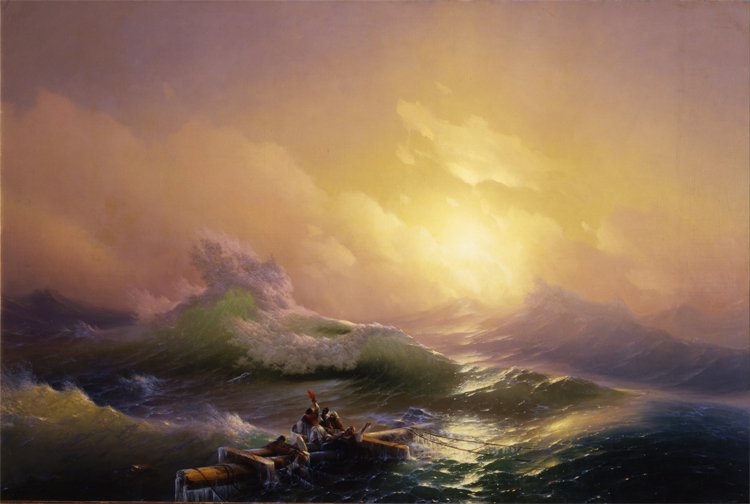
Each of the artworks discussed above contributes rich layers to our understanding of the ocean and its representation in art. From Aivazovsky’s The Ninth Wave (1850) to Courbet’s The Wave (1869), the ocean remains a versatile subject, opening dialogues about fear, hope, beauty, and the human condition. Notably, Courbet’s depiction where one sees only the wave and sky evokes a sense of solitude, highlighting the intrinsic connection between humanity and nature.
Lastly, Claude Monet’s Stormy Sea in Étretat (1883) captures the dynamic interplay of light and shadows, as waves crash against cliffs, demonstrating an evolving appreciation for nature’s artistry. This work stands as an homage to the impressionist movement, showcasing how personal experience shapes artistic expression.
In summary, the ocean has been a perennial source of inspiration for artists, echoing humanity’s varied relationships with nature. Whether through depictions of chaos, calm, or cultural significance, these iconic pieces paint a comprehensive portrait of the sea’s complex allure. For more insights into ocean-inspired art, visit SurferToday.com. Each painting tells a story, urging us to explore not just the depths of the ocean, but the depths of our connection to it.
This article is based on reporting from www.surfertoday.com.
The original version of the story can be found on their website.
Original Source:
www.surfertoday.com
Image Credit: www.surfertoday.com ·
View image