


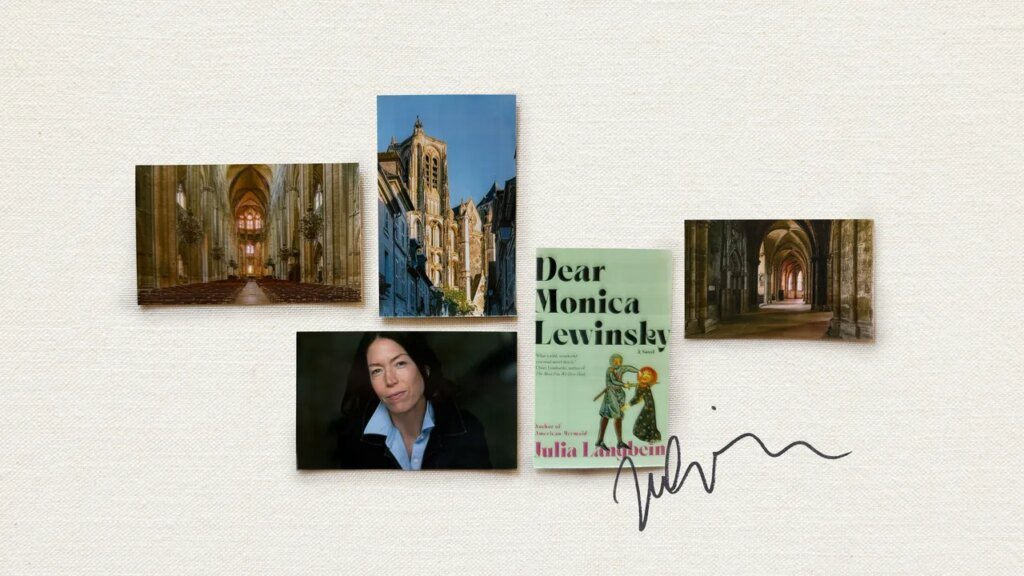
Discovering Inspiration in the Cathedrals of France: Julia Langbein’s Journey
In this edition of Write Here, celebrated author Julia Langbein recounts her evocative travels through Amiens and Bourges, France, which served as a poignant backdrop for her latest novel, Dear Monica Lewinsky. In this compelling narrative, the character Jean Dornan reflects on her study-abroad experiences, notably an affair with her medieval art history professor in the summer of 1998—an era marked by President Bill Clinton’s admission of a sexual relationship with Monica Lewinsky. This paradoxical intersection of personal and political tumult frames the narrative, allowing Lewinsky to emerge as a symbolic patron of those enduring public shaming and patriarchal injustices.
Langbein’s journey to Amiens and Bourges serves as a significant milestone in her creative process. This author, equipped with a PhD in art history and a background in comedy, aims to explore the interplay between human experiences and divine architecture within cathedral towns. Her exploration is not only about heritage but also about infusing her writing with authentic emotional depth. Dear Monica Lewinsky weaves together personal experiences and historical context, creating a narrative steeped in both humor and pathos.
In 2023, Langbein ventured into the picturesque towns of Amiens and Bourges, initially sparked by her proximity to these architectural marvels living just outside Paris. The trip to Amiens was timed with a visit from her parents, a dual opportunity to revisit cherished locations and experience them with family. The Cathédrale Notre-Dame d’Amiens, a magnificent 13th-century edifice, held personal significance as Langbein’s father had studied its history. However, as she roamed the hallowed halls, she found herself grappling with an internal conflict—her thoughts consumed by her parents’ comfort rather than her own creative needs.
As a writer, Langbein soon realized that balancing family obligations with the demands of her creative process proved challenging. While the stunning cathedral stirred reflections and inspiration, the weight of familial responsibility overshadowed her artistic pursuits. Her experiences highlight a universal struggle for creators—maintaining personal space amid familial connections. Langbein’s candid admission underscores the tension between obligations and inspiration, reminding us that even as artists seek to draw from their surroundings, life’s interruptions can complicate the creative flow.
Months later, seeking renewed inspiration for a crucial scene in Dear Monica Lewinsky, Langbein embarked on a solo journey to Bourges, home to the impressive Cathédrale Saint-Étienne de Bourges. Renowned for its architectural unity and grand nave, this Gothic masterpiece beckoned her. However, even with the anticipation of artistic revival, Langbein found herself questioning the necessity of her visit. Was her presence justified, or was it superfluous in light of the extensive research she had conducted prior? Such moments encapsulate the complexities of travel for inspiration and the often-misguided self-doubt that plagues creatives.
In Bourges, Langbein’s experience veered away from mere historical observation. The charm of Tudor-style homes, vibrant cafés, and delightful culinary offerings, such as inexpensive duck paired with local red wine, created an enchanting atmosphere. Though initially wrought with feelings of impostor syndrome, these interactions with the local culture illuminated the unique humor and normalcy of cathedral towns. The juxtaposition of everyday life against grandiose cathedrals exposes a layered reality, where monumental significance coexists with the humorous mundanities of life.
Ultimately, Langbein’s travels in France illuminated the human experience within sacred spaces, enriching her narrative in Dear Monica Lewinsky. While the towering cathedrals stand as testaments to faith, the towns themselves are repositories of laughter, stories, and hidden struggles. This interplay between the divine and the mundane prompted her to craft a richer, more engaged narrative that resonates with readers. Through her journey, we are reminded that inspiration often dwells within the nuances of our experiences, urging us to explore beyond the surface of grand monuments to discover the compelling stories they effortlessly harbor.
For further exploration of Julia Langbein’s works, visit her publisher’s website or read more about her insights on writing and travel at her personal blog. Discover how the beauty and complexity of France’s cultural heritage can inspire not only a novel but also a profound understanding of our shared human struggles.
This article is based on reporting from www.cntraveler.com.
The original version of the story can be found on their website.
Original Source:
www.cntraveler.com
Image Credit: www.cntraveler.com ·
View image