


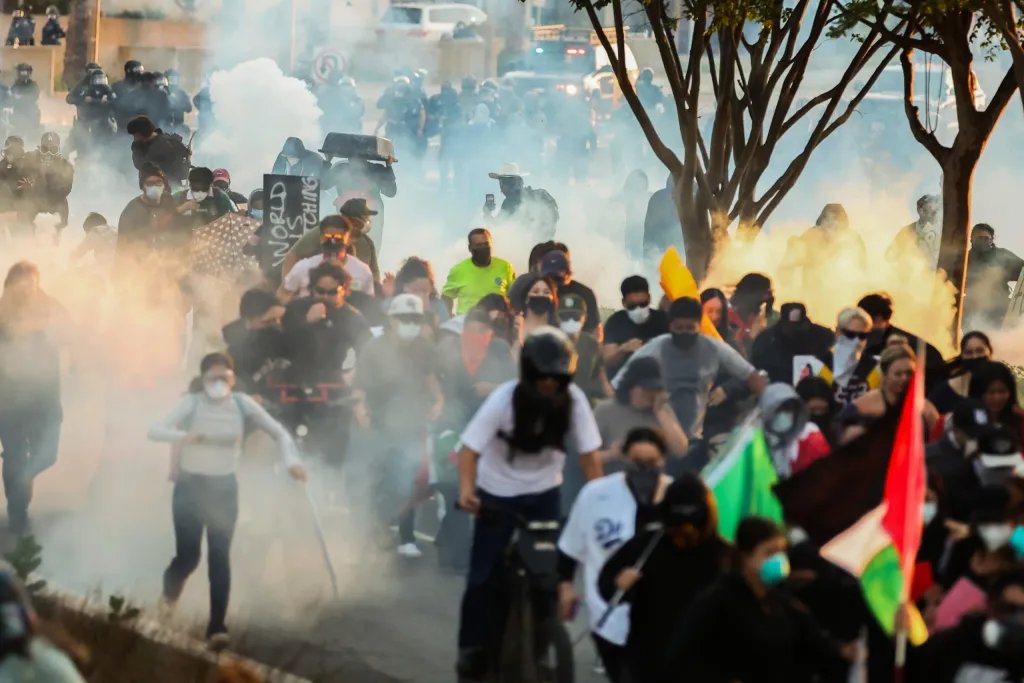
On a scorching June day in 2025, the streets of Santa Ana were alive with demonstrators, chanting against expanded ICE deportations. Amid the fervor of protest, the sound of rubber bullets ricocheted against walls, mingled with cries for justice. What began as a peaceful assembly morphed into chaos as police unleashed tear gas on the crowd. “It felt surreal, being fired upon for just standing up for our rights,” said protester Maria Gonzalez, a local activist.
Santa Ana’s Confrontation: A Tale of Protest, Police Response, and Public Outcry
The protests against Immigration and Customs Enforcement (ICE) agents revealed deep-seated tensions between community advocates and law enforcement in Orange County’s sole sanctuary city. Local government had publicly declared their acceptance of federal assistance during the protests, raising eyebrows and questions about the extent of police authority and community safety. “It wasn’t a matter of choice; it was about the fear of federal reinforcement,” explained City Attorney Sonia Carvalho, recalling the federal attorney’s calls for assistance during demonstrations.
The Cost of Response
The financial implications were staggering—nearly $400,000 spent in four days of protests prompted by community anxieties over immigrants’ rights. “Inflated sums spent could have been better allocated towards community support initiatives rather than suppression tactics,” remarked Dr. Sheila Fernandez, a sociologist specializing in community policing at UCLA. Her recent study indicated that cities investing in community dialogue preemptively reduce the likelihood of violent confrontations during protests by up to 40%.
- Heightened police presence led to:
- Excessive use of non-lethal projectiles
- Community trust erosion
- Legal liabilities with ongoing lawsuits
The response from law enforcement has been met with skepticism from residents and city officials alike. Questions lingered during city council meetings regarding the rationale behind the decision to engage protesters with bean bags and tear gas. “What was the actual threat we perceived? Our demands were peaceful,” Councilwoman Jessie Lopez pressed, echoing a sentiment shared by many attendees of the demonstrations.
Legal and Ethical Dilemmas
Looming lawsuits have presented additional complications, as the city grapples with claims that officers acted excessively during the protests. One such case involves Tony Olson, who alleged he was injured by police projectiles. Carvalho indicated during council discussions that legal defense could deflect responsibility onto federal agents. “The intent is to protect the city from potential liabilities while navigating these sensitive issues,” she stated, but such rationalizations do little to calm a community grappling with distrust.
The Spectrum of Violence
Yet, amidst discussions of legal recourse, social scientists stress that the prevalence of violence observed during protests is often influenced by police actions. “When law enforcement shows first signs of aggression, it tends to escalate crowd response, leading to reactive violence,” noted Dr. Adrian Shields, a conflict resolution expert. His research indicated a direct correlation between police engagement styles and the intensity of crowd reactions.
Councilman Jonathan Hernandez, who found himself in the midst of the protests, voiced concerns over the police’s portrayal of events. “We need more transparency and to discern between actual threats and perceived threats,” he said, suggesting that video footage from the event could serve as evidence of disproportionate responses from law enforcement. “The truth is, many of us weren’t violent; we were peacefully advocating for our community.”
Looking Forward
The aftermath of protests remains shrouded in controversy. As city officials navigate their legal standings amidst calls for accountability, a crucial question arises: How can Santa Ana forge a path toward reconciliation? Some community leaders express hope, advocating for expanded training for police in de-escalation strategies and crisis intervention. “Community healing is essential,” emphasized activist Leticia Ruiz. “If the police want to reclaim trust, they must engage with us, not against us.”
Furthermore, an investor-backed research project is in the works, designed to analyze the impacts of police-community engagements on public sentiment. The hope is that data will shed light on policing strategies that foster collaboration rather than hostility.
In the shadow of Santa Ana’s tumultuous protests, the chords of conflict resonate deeply within the community. With leaders steeling for legal battles and activists clamoring for justice, the road ahead is fraught with challenges. But as the dust settles, the need for dialogue, accountability, and genuine community connection is clearer than ever.