


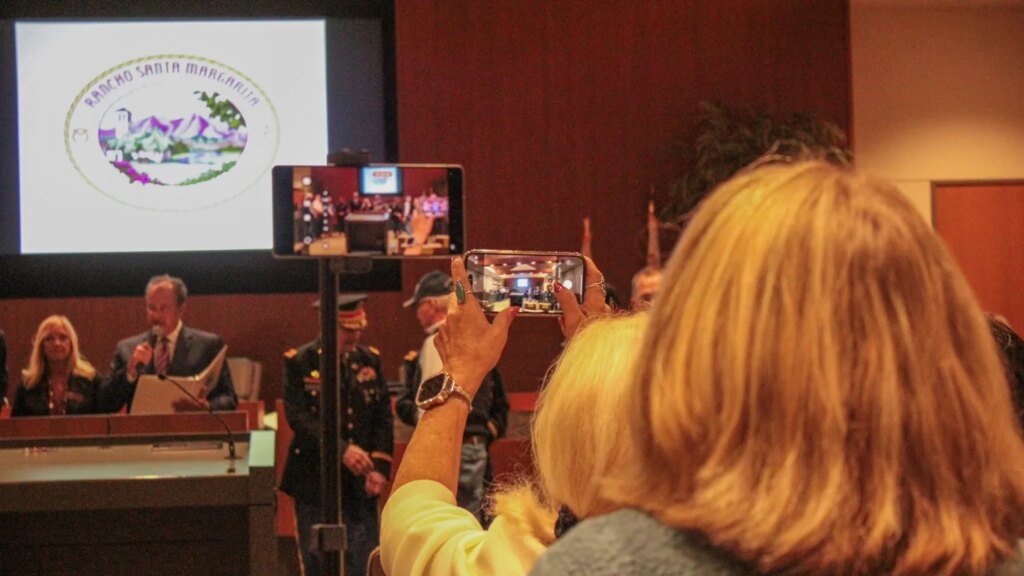
In the backdrop of a sunsetting Orange County skyline, residents of Rancho Santa Margarita embody a democracy invigorated by grassroots activism. With a population of nearly 50,000, this idyllic city—a picturesque blend of suburban tranquility and modern amenities—has recently witnessed a shift: its citizens, disenchanted with a lack of governmental transparency, have taken the reins by individually videotaping city council meetings. Amidst the growing concerns about local governance, it highlights a broader quest for accountability in California’s civic life.

Rancho Santa Margarita Residents Demand Transparency
This surge for transparency follows a groundbreaking investigation by students at Voice of OC, revealing that Rancho Santa Margarita is one of only two cities in Orange County without a system to broadcast city council meetings to residents. While 94% of the county’s 34 cities have embraced this technology, Rancho Santa Margarita maintains a status quo that limits visibility into local governance.
A Call to Action
In response to this revelation, citizens spearheaded by Amber Bloomer have mobilized under the banner **RSM4All**. The group’s mission is clear: to democratize access to city governance through digital means. “It’s not a Blue or Red issue; it’s about getting involved. We need to pay attention,” Bloomer asserted with a resolve that resonates deeply within the community.
Residents began recording meetings and posting them on their YouTube channel, **Rancho Santa Margarita Citizens 4 Transparency**. This initiative has provided a lifeline for residents who wish to stay informed but cannot attend meetings in person.
- Community leaders have emphasized the need for transparency in decision-making.
- Residents have expressed concerns regarding accessibility, especially for those with disabilities.
- Local officials have faced criticism for inaction on videotaping council sessions.
Resident Testimonials
Cindy Ashley, a member of RSM4All, highlighted the challenges of engaging with local government through audio recordings alone. “Even as a person without any disability, I find it hard to always know who is speaking,” she lamented. “When there is a video presentation, you miss that content. It would be so much easier to follow along as it is discussed live.” Her sentiments echo a growing dissatisfaction among citizens regarding a perceived opacity in their local government.
Official Resistance
Despite these grassroots efforts, city leaders, including Mayor Anthony Beale, have appeared reluctant to adopt video broadcasting. When approached for comment, city officials advised that they are awaiting guidance from Sacramento, which raises questions about local governance autonomy. “This doesn’t seem to align with the values of local democracy,” remarked political analyst Dr. Maria Sanchez. “When citizens have to take it upon themselves to ensure transparency, it speaks volumes about their trust—or lack thereof—in their elected officials.”
Systemic Failures
The ramifications of this lack of transparency are significant. For instance, residents have noted that the audio recordings offered by the city are often inadequate, making participation challenging. Tasia Surch, a local resident who uses hearing aids, pointed out that her ability to engage with council meetings has been severely compromised. “Your audio recordings are of no value to me,” she stated during a recent public comment session, underscoring the urgent need for audiovisual support for disabled residents.
Unfortunately, the lack of adequate engagement has resulted in missed opportunities for meaningful community interaction on crucial issues, ranging from internet accessibility to budget allocations. As Surch mentioned, “The council isn’t just making decisions for themselves; they are impacting our daily lives.”
Civic Action Revolutionized
During a recently attended city council meeting, the palpable sense of community spirit was evident. With each resident who spoke out against the absence of video access, there was hope for change. Dr. Hank Williams, a sociologist focused on civic engagement, noted, “What we’re witnessing in Rancho Santa Margarita is a microcosm of a larger societal shift. When traditional systems fail to meet the demands of the populace, it is the populace that adapts and rises to meet the challenge.”
This spirit of innovation and activism not only honors valuable civic duties but also empowers communities to hold their leaders accountable. Video recordings of city meetings allow for a permanent record, fostering informed discourse and enabling citizens to engage deeply in local governance.
Prospects for Change
Interestingly, San Diego Assemblymember Maria Elena Durazo initially proposed legislation to modernize California’s open meetings law, but ultimately stepped back from mandating cities to videotape meetings. Despite this withdrawal, the fact that Rancho Santa Margarita residents will not wait reflects a transformative moment—a realization that transparency is a right, not a privilege.
With residents like Bloomer and Ashley spearheading these efforts, there is potential for a brighter future where citizens can engage with their local government purely through informed choices and discussions—where every voice is valued and heard. This movement not only strengthens democratic processes but reaffirms a basic tenet of civic engagement: that an informed citizenry is vital for a healthy democracy.
The actions taken by these residents not only honor those who have served in various capacities within their community but set a precedent for future civic interactions. As the sun sets behind the hills of Rancho Santa Margarita, it casts a hopeful glow on a community fighting for its right to transparency, empowerment, and a participatory government.