


Pressure Mounts for Gov. Gavin Newsom to Expedite Orange County’s First Veterans Cemetery
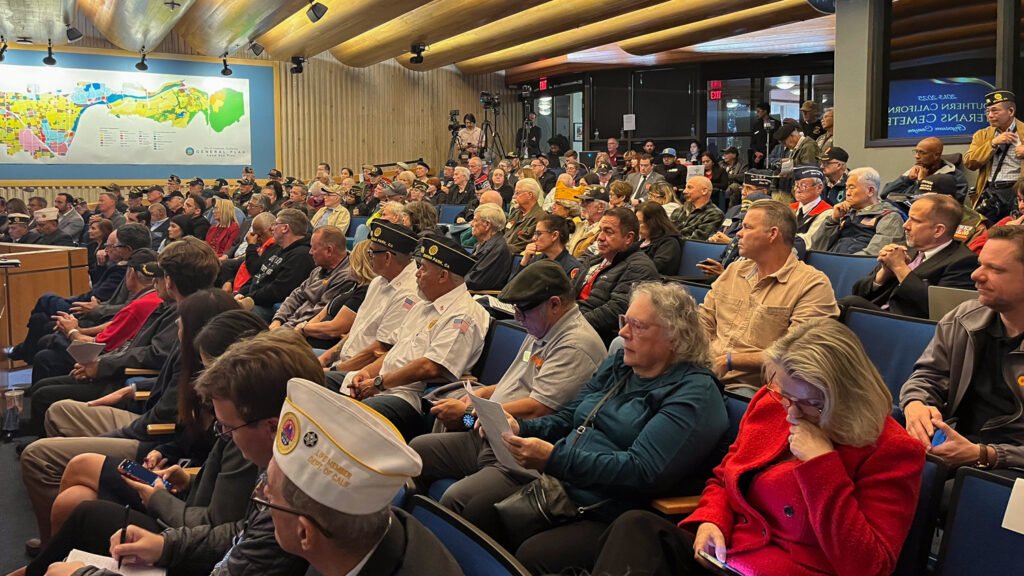
On a sweltering Friday afternoon, the air in Anaheim city hall was thick with palpable frustration as hundreds of veterans and their advocates filled the benches, seeking answers about the long-awaited veterans cemetery in Orange County. Instead of clarity, they encountered a bureaucratic wall—state staff announced that they would not commit to a timeline for breaking ground, indicating a new study would be submitted only in June 2026. The tension escalated when Nick Berardino, president of the Veterans Alliance of Orange County, called out, “Our people are dying!” underscoring the urgency of the situation.

A Legacy of Delays
The journey to establish the cemetery dates back over a decade to 2012, marred by disputes over the site and funding shortfalls. Despite over $55 million being allocated by both county and state for this vital project, its actualization remains frustratingly elusive. With an increasing number of veterans passing away without a proper resting place, local frustrations have reached a boiling point. Ryan Thompson, a sociologist specializing in veteran affairs at the University of California, argues, “It reflects a systemic failure to prioritize those who have served our country. Research consistently shows that veterans often face significant bureaucratic challenges when it comes to accessing basic needs, including dignified burial spaces.”
Voices of Discontent
The emotions expressed during the legislative hearing were a mirror of this systemic struggle. “They slapped every veteran in the room today,” Berardino stated later, emphasizing that such delays are perceived as a betrayal of those who served. Nancy Soltes, a Gold Star mother, passionately told state officials they “should be ashamed” for dragging their feet on a project so crucial to veteran dignity.
- Emotional Strain: Many veterans feel that the lack of action demonstrates a disregard for their sacrifices.
- Financial Consequences: Delays are projected to increase construction costs, straining already allocated budgets.
- Desire for Leadership: Calls for immediate action by state officials highlight a perceived void in leadership.
As emotions flared, several local leaders reiterated that the project hinges on action from Governor Newsom. State Assemblymembers Sharon Quirk-Silva and Avelino Valencia jointly advocated for the immediate transfer of the land to the California Department of Veterans Affairs (CalVet), stating, “If the governor does not act, we will introduce legislation to make it happen.” In an environment ripe with skepticism about bureaucratic inertia, the urgency is becoming increasingly concrete.
A Call to Action
County Supervisor Don Wagner echoed the sentiment, expressing disappointment in the current state of affairs. “The next steps are with the governor,” Wagner said. His frustrated tone resonated with many attendees, some of whom labeled the orchestrated bureaucratic waiting as a “filibuster,” a deliberate stalling tactic undermining the needs of veterans.
Long Beach’s Vietnam Veterans of America Chapter 756 vice president, Brian Heyman, emphasized the financial implications of further delays. “The longer we wait, the more it’ll cost. Get the governor on board,” he urged, a sentiment that many around the room could enthusiastically support.
Federal Funding and Complications Ahead
Recent developments offer a glimmer of hope: earlier this year, federal funding was approved for the Gypsum Canyon site, positioned conveniently just off the 91 Freeway and 241 Toll Road. Tim Deutsch, general manager of the OC Cemetery District, expressed optimism about collaboration with the state to reduce costs but acknowledged complications arising from the shared site with a public cemetery. State officials noted that no arrangement is currently in place for splitting costs, with Deputy Secretary of Veterans Affairs Roberto Herrera stating, “It’s not up to us when the state takes over the land.”
The Broader Context
This ongoing delay is part of a larger narrative regarding veterans’ issues and public service obligations, and these recurring frustrations speak to systemic inadequacies that veterans face nationwide. According to a study conducted by the Veterans Research Institute, nearly 40% of veterans report feeling neglected by state and federal institutions. “Investing in veteran services should be non-negotiable,” says Dr. Elizabeth Harmon, a veteran affairs expert and author of “Honorably Discharged: A Guide to Veteran Resources.” “When timelines are extended with no accountability, it sends a clear message of neglect.”
Meanwhile, many are left wondering about the potential fate of this cemetery once construction begins. Discussions of escalating costs emphasize an urgent need for proactive measures. Jason Kenney from the California Department of General Services revealed that estimates from 2023 lean toward $120 million but cautioned that these figures are likely outdated. “It’s essential that we address these budget concerns sooner rather than later,” he stated tersely.
The veterans and their advocates gathered at Anaheim city hall left that day with more questions than answers, their hope for a dignified resting place currently overshadowed by bureaucratic stasis. As the wall of red tape continues to loom large, one thing remains abundantly clear: the urgency of action cannot be overstated. In the face of mounting pressure, it is time for Governor Newsom to prioritize veterans and give them the cemetery they’ve long deserved.