



Understanding Wave Generation: Exciting Experiments for All Ages
Have you ever marveled at the sight of ocean waves crashing against the shore? While they might seem spontaneous, waves are the result of various natural forces. Let’s explore exciting and educational ways to simulate wave generation at home that will captivate both kids and adults alike. Whether you’re a teacher, parent, or simply curious, here are six engaging methods to illustrate the beauty of wave dynamics.
The Jump Rope and Garden Hose Experiment
A classic way to demonstrate wave generation is with a jump rope or garden hose. In this simple setup, stretch the rope or hose across your yard. With a flick of your wrist, you’ll create ripples that mimic ocean swells. This exercise effectively illustrates key wave characteristics such as amplitude (wave height), frequency (how quickly you shake it), and wavelength (distance between peaks). As you move the rope, observe how the energy travels while the rope stays in place, highlighting the distinction between wave motion and water currents. For a deeper dive into wave behavior, check out the resources on wave dynamics.
Creating Ripples with a Water Bowl
Another straightforward method involves a shallow bowl of water. A simple tap of your fingertip or a droplet can create ripples that spread outward in concentric circles. This experiment demonstrates how different forces produce varying wave patterns. A gentle drop yields softer ripples, while a heavier tap creates sharper lines. To enhance visibility, consider adding floating pieces of pepper or crumbs that act as markers for the energy passing through the water. You can also gently rock a wider basin; as you push and pull, the water eventually finds its rhythm, much like real ocean waves forming under consistent wind patterns. Explore more about ripple effects on fluid dynamics.
Exploring Waves with a Slinky
For a hands-on experience, use a Slinky to visualize both longitudinal and transverse waves. By stretching it across a flat surface, you can demonstrate transverse motion by moving one end up and down. This action creates visible ripples traveling along the Slinky. Conversely, pushing and pulling the Slinky mimics the compressions and rarefactions of longitudinal waves. This dual-purpose experiment not only showcases energy transfer but also allows for an engaging group activity where one participant creates waves while another reflects them to gain further insights into wave behavior. For more interactive science experiments, visit science for kids.
Visualizing Sound Waves with Rice or Salt
Sound waves are often invisible, but you can make them visible with a few household items. Stretch plastic wrap over a bowl, sprinkle some rice or salt on top, and place a speaker underneath. When you play bass-heavy music, you’ll observe how the sound vibrations create distinct patterns on the surface. Different frequencies will generate different movements, demonstrating that both sound waves and ocean waves are mechanical in nature—they transfer energy through a medium without physically moving the matter itself. This experiment serves as a fantastic segue into discussions on sound and waves.
The Chain Reaction Wave Experiment
To illustrate energy transfer in a more relatable way, line up dominoes or blocks closely together. A gentle nudge to the first block sets off a chain reaction that visually represents wave propagation. Each object transmits the energy of the push to the next, creating a wave-like effect. This experiment highlights the principle of minimal movement required to pass energy through a medium, showcasing how waves propagate without the bulk movement of water. For further exploration of energy transfer, check out resources on kinetic energy.
Simulating Wind-Generated Waves with a Hairdryer
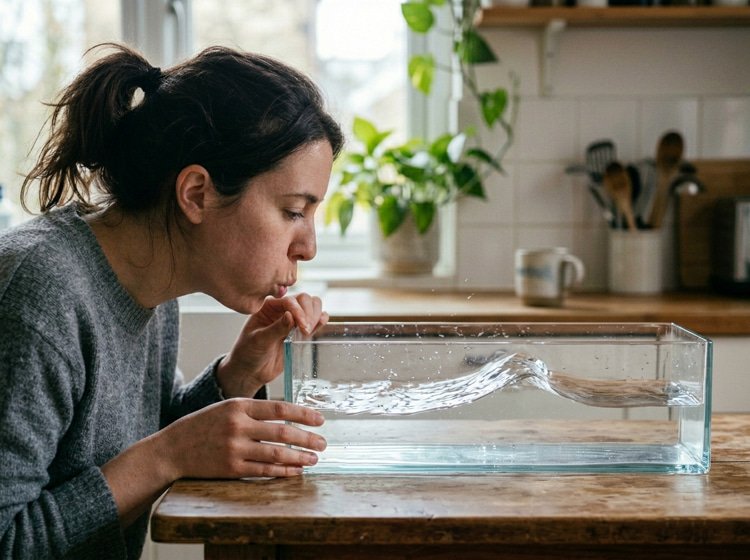
Finally, to closely replicate ocean wave behavior, utilize a hairdryer to create your own wind. Fill a shallow tray or bowl with a thin layer of water and let it settle. Turn on the hairdryer at a low setting, aiming it at a shallow angle across the water’s surface. This will initiate tiny ripples, mimicking the initial impact of a light breeze on the ocean. As you gradually increase the airflow, observe how the ripples transform into aligned waves, demonstrating how wind transfers energy unevenly across water surfaces. This experiment illustrates key oceanographic principles, including how offshore winds affect wave size and shape. For more captivating ocean science projects, check out learn about ocean waves.
Conclusion
Understanding wave generation can be both educational and entertaining, especially when you engage in these hands-on experiments. Whether you’re creating ripples in a bowl or simulating ocean waves with a hairdryer, these activities provide valuable insights into the mechanics of wave behavior. Perfect for family fun, classrooms, or curious minds, these simple experiments can lead to a deeper appreciation for ocean dynamics and physics. Start exploring these phenomena today!
Further Reading
For more information on ocean waves and physics, check out Oceanography and Physics Experiments.
This article is based on reporting from www.surfertoday.com.
The original version of the story can be found on their website.
Original Source:
www.surfertoday.com
Image Credit: www.surfertoday.com ·
View image