



Breaking the Two-Hour Marathon Barrier: A Historic Moment in Running
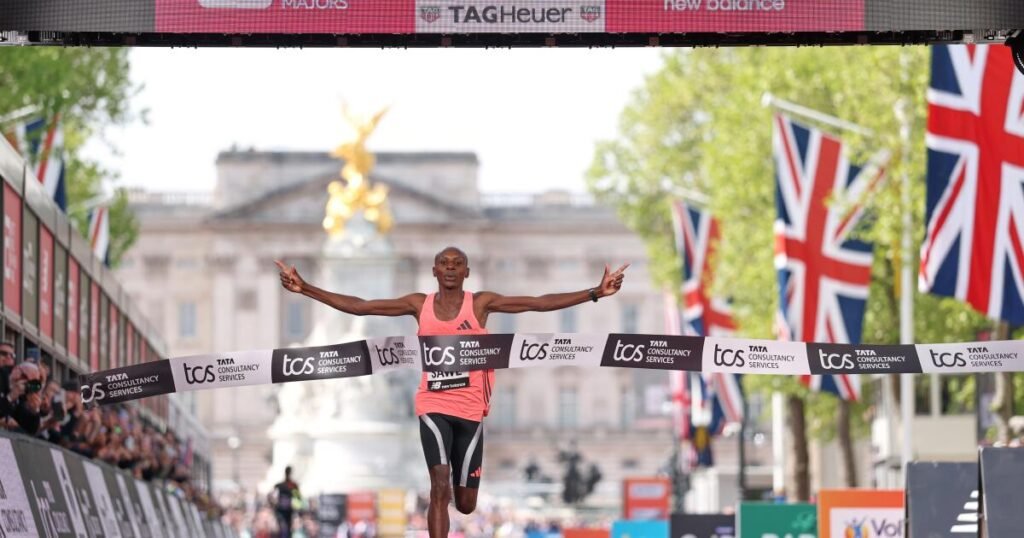
The marathon world has witnessed an extraordinary transformation with the official breaking of the two-hour barrier in marathon running, a feat once considered impossible. Two runners, Kenya’s Sabastian Sawe and Ethiopia’s Yomif Kejelcha, made history in the London Marathon, establishing fresh records that highlight the pinnacle of human athletic capability. Sawe completed the grueling 26.2 miles in an astonishing 1 hour, 59 minutes, and 30 seconds, surpassing the previous men’s world record by a remarkable 65 seconds. With Kejelcha, in his marathon debut, finishing just 11 seconds afterward, this event marked an unforgettable chapter in the realm of sports.
The race itself was a spectacle, showcasing Sawe’s exceptional endurance and competitive spirit. He accelerated through the second half, clocking in at 59 minutes and 1 second. By the 30-kilometer mark, Sawe and Kejelcha had built a significant lead, but it was Sawe’s final sprint along The Mall that solidified his remarkable victory and stirred excitement among the massive crowds that lined the London streets. "This day is not just for me," Sawe said post-race, acknowledging the role of the audiences in fueling his triumph. Their cheers inspired him to push beyond previous limits, embodying the collective spirit of the spectators and participants alike.
Historically, breaking the two-hour mark in a marathon has been an elusive target. While Eliud Kipchoge famously achieved a time of 1:59:40 during the “1.59 Challenge” in 2019, that event was not officially recognized as it took place under controlled conditions with specialized pacing. The true essence of Sawe’s achievement is rooted in his ability to surpass Kipchoge’s time in a competitive marathon setting, showcasing that elite runners could not only chase but achieve dreams that once seemed unthinkable. The bar for marathon excellence has undoubtedly shifted, and experts suggest that current training methods and advancements in sports science have contributed to this significant leap.
The implications extend beyond men’s running, as the women’s event in the London Marathon also witnessed a noteworthy record. Ethiopia’s Tigst Assefa finished with a time of 2:15:41, making it the fastest-ever time for a women’s-only marathon, even though it fell short of the overall course record established by Paula Radcliffe in 2003. This race saw an unprecedented moment where three women finished under 2:16, showcasing the increasing competitiveness and depth of talent in women’s marathon running. Assefa expressed exhilaration at her achievement, vowing that her rigorous preparation had finally paid off.
This marathon also emphasizes the evolving landscape of elite athletics, where performances are continually being redefined. Paula Radcliffe remarked on this transformation, noting that the record for men’s marathon running has significantly dwindled, from Khalid Khannouchi’s 2:05:42 in 1999 to now, as a new generation of athletes pushes the limits further. The race marked not just a day of personal accomplishments for runners but an era of newfound expectations where previous standards are being surpassed.
Moreover, the wheelchair races added to the excitement with extraordinary performances as well. Swiss athlete Marcel Hug clinched his sixth consecutive men’s title while Catherine Debrunner defended her title in a thrilling finish against Tatyana McFadden. The coordination and synergy of these elite athletes exemplify the dedication and relentless spirit that marathon running encapsulates.
In summary, the London Marathon was not merely a race; it was a historic event that redefined the thresholds of human performance in athletics. Sawe’s and Assefa’s achievements will inspire future generations of runners, setting new benchmarks in marathon history. As we reflect on this monumental occasion, it’s clear that the narrative of endurance has forever changed, opening avenues for remarkable athleticism and continuous breakthroughs in training and methodologies within the running community. The dream of breaking barriers has propelled athletes not only to new heights but into a new dimension of possibility, fueling the momentum of marathon running for years to come.
This article is based on reporting from www.latimes.com.
The original version of the story can be found on their website.
Original Source:
www.latimes.com
Image Credit: www.latimes.com ·
View image